Showing posts with label Review. Show all posts

Sunday, March 6, 2016

Toyota RAV4 2001. - 2005. - expert review


Toyota RAV4 2001. - 2005.
2001 - 2005 Toyota RAV4, (Photo: Toyota Canada)
The 2001-2005 Toyota RAV4 is one of the most fuel-efficient SUVs on the market after hybrids. With its sleek, sporty styling and great fuel economy, the RAV4 is a good choice if you need a small practical SUV. 
Available as two- or four-wheel drive, the RAV4 has a car-based unibody construction with a 4-cylinder engine and a five-speed manual or four-speed automatic transmission. The 2001, 2002 and 2003 RAV4 came with the 148-hp 2.0-liter 4-cylinder DOHC engine with Variable Valve Timing with intelligence (VVT-i). Starting from the 2004, the RAV4 received the 161-hp 2.4-liter engine. Both engines use a maintenance-free timing chain; there is no timing belt to replace. Both engines are reliable if maintained properly.
Toyota RAV4 2001. - 2005.
2005 Toyota RAV4 interior. (Photo: Toyota Canada)
Toyota RAV4 2001. - 2005. cargo area
2005 Toyota RAV4. (Photo: Toyota Canada)
Toyota RAV4 2.4L engine
2005 Toyota RAV4 2.4L VVT-i engine. Photo: Toyota Canada
Toyota RAV4 EPA Fuel Economy:MPG
city/hwy
L/100 km
city/hwy
2001-2003 2WD manual22/2810.7/8.4
2004-2005 2WD manual21/2711.2/8.7
2001-2003 2WD auto21/2611.2/9.0
2001-2003 4WD auto, manual20/2511.8/9.4
2004-2005 4WD auto20/2411.8/9.8
2004-2005 4WD manual19/2512.4/9.4
AWD system: The RAV4's full-time 4WD system uses a viscous coupling center differential to distribute power to the front and rear wheels. When front wheels start slipping, more power is transferred to rear wheels and visa versa. Although this four-wheel drive system is not designed for real off-roading, it will offer you some advantage on slippery roads. 

Inside: The RAV4's interior is simple and comfortable. High driving position offers very good all-around visibility. Controls are conveniently located and easy to use. Fit and finish is good. The rear swing door glass does not open separately as in the Honda CR-V, but the low cargo floor makes loading easier. On the downside, the rear seat space is fairly limited and the driver's seat feels a bit small. 

Handling: Toyota RAV4 is agile and fun to drive. It handles like a car and has a fairly smooth ride. Tight turning circle makes it feel very maneuverable around town. The engine is a bit noisy and lacks highway passing power, but is very fuel-efficient.

Pros: Sleek styling, versatility, fuel economy, car-like handling, fun to drive, reliability 

Cons: Front seats are not very comfortable, limited space, rear door glass doesn't open separately, lack of highway passing power, road noise, engine noise, rattles 

Fuel Economy: The RAV4 is one of the class leaders in terms of fuel economy. With mostly highway driving, the 2005 FWD RAV4 with a manual transmission gets up to 346 miles (557 km) on a 14.8-gallon (56 L) tank. 

Overall: If you want an inexpensive used 4WD vehicle that is good on gas, there aren't that many options. The RAV4 is reliable, easy to maintain and widely available on the used car market. Thanks to Toyota reputation for reliability, the RAV4 holds value well and you won't have troubles selling it. Maintenance costs are pretty low compared to other SUVs.
The 2001-2005 RAV4 didn't have too many problems, but there were some complaints about the automatic transmission shifting problems caused by a faulty ECM (engine computer) in the 2001-2003 models; read more on the next page. Still the overall reliability is above average. Among competitors, consider Subaru Forester or Honda CR-V; both are pretty good choices. Read about Toyota RAV4 common problems on the next page. 
Toyota RAV4 problems: A faulty ECM (engine computer) in 2001-2003 models can cause a problem with the way the automatic transmission shifts. According to many sources, the ECM warranty has been extended to 10 years or 150,000 miles. If you suspect having this problem in your RAV4, you might want to check with a Toyota dealer. The ECM needs to be replaced with an updated part to address this issue. 
A few other things to know about: Leaking engine valve seals can cause a blue or grey smoke at start-up. The air/fuel ratio sensors are fairly common to fail, often causing the Check Engine light with the code P1155. The mass airflow sensor can get dirty causing hesitation on acceleration.

What to look for when buying a used Toyota RAV4: Before buying a used RAV4, check its history records, to verify that the vehicle wasn't involved in an accident or had other problems in the past. Watch out for a blue or grey smoke on start-up after the vehicle was sitting for a while. Usually it's more noticeable when the engine is started cold in the morning. Commonly the smoke is caused by bad valve seals. For 2001, 2002 and 2003 RAV4, you may want to check if the ECM has already been replaced with an updated part. 
If the "Check Engine" light is on, have the problem checked out before buying a vehicle. When test-driving, make sure, the automatic transmission shifts properly and smoothly in all conditions. Read our illustrated used car checklist for more info. Have the vehicle properly inspected before buying. Consider an extended warranty at least for the powertrain to protect from unexpected repair costs.
Maintenance tips: Keep your tires properly inflated. Change transmission fluid regularly; it's best to use genuine Toyota transmission fluid. You can find transmission fluid capacity in the 'Specifications' section of your owner's manual. Keep all other fluids clean and topped up. In the 4WD models, transfer case oil and rear differential oil also need to be replaced regularly. If you notice any issues with the way the automatic transmission shifts, have it looked at before the problem gets worse. 
Regular oil changes will help to keep the engine running longer. Toyota recommends using 5W-30 oil. When replacing a faulty ignition coil, it's good idea to replace all the spark plugs if they are old. When doing any repairs, it's always better to use original Toyota parts. 
Have your vehicle inspected in a repair shop annually to keep it safe. You can check the maintenance schedule online at the Toyota Owners website. The same website provides access to the electronic copy of the owner's manual. 

2005 Toyota RAV4 short specifications

Dimensions:
Overall length: 
Overall width: 
Overall height: 
Wheelbase: 
166.6 in(4232 mm)
68.3 in (1735 mm)
66.1 in (1680 mm) (4WD model)
98.0 in (2490 mm)
Seating capacity:

Cargo capacity:
Behind rear seats:
With rear seats out:
29.2 cu. ft
68.3 cu. ft 
Towing capacity:
1500 lb. (680 kg)
Engine:

2.4-liter DOHC 16-valve 4-cylinder with VVT-I 
161 hp @ 5,700 rpm, 165 lb-ft @ 4,000 rpm 
Recommended Fuel:
Regular unleaded 
Fuel Tank Capacity:
14.7 US gallons (56 liters) 
Engine Oil Capacity L4-2.4L (2AZ-FE):
With filter: 4.0 US qt. (3.8 L) 

2009 TOYOTA COROLLA REVIEW


2009 Toyota Corolla


2009 Toyota Corolla
Chances are, you know someone who owns or has owned a Toyota Corolla, or own one yourself. Think about it. This is because right now, a Corolla is sold about every 23 seconds. Since 1966, Toyota has sold around 30million Corollas. Being the best selling car in the world, the Corolla has always provided its buyer with unmatched reliability, safety, and fuel economy.
Completely redesigned for 2009, this tenth generation Toyota Corolla shows no signs of running out of steam.
The thing about Toyotas is that they’re really good at what they do, and that’s all. No flair, no personality; many have called Toyotas simply an “appliance” – a refrigerator on wheels. But is that necessarily a bad thing? Not for most people, apparently. Most Corollas are sold to people who say “Cars are for getting you from Point A to Point B.” These are people who care about reliability over excitement, fuel economy over power, and safety over fun. I happen to not be one of those people, but I’m not quite comfortable saying I disliked the Corolla, either.

Styling

2009 Toyota Corolla
2009 Toyota Corolla
If you’ve ever had a younger sibling of the same sex, then you must understand how the Camry feels when looking at the Corolla. Exterior styling on the 2009 Corolla is a bit funky, much like a younger brother trying to mimic the style of his older brother (the Camry, in this case.) I suppose it makes sense, since Toyota was going for a younger crowd with this one.
Inside, the design holds to the same principal of Corollas of yore. Simple, no extreme lines, basic, and utilitarian. Controls are simple and well laid-out, making everything easy to use and understand immediately. The fake wood trim looked strange, but did break up the otherwise monochromatic interior.

Driving

2009 Toyota Corolla XLE gauges
Electroluminescent gauges on XLE
Despite this being the tenth generation Corolla, it really doesn’t feel that much different than my friend’s 1995 Corolla, or even previous models. Toyota is staying true to what the car is, and that is one reason it’s continuing to sell as well as it is. Plus, why mess with a winning formula? Sure, it’s fancier and shinier and more modern, but the driving dynamics and interior feel haven’t changed that much. It’s a good thing.
Driving is comfortable. Smooth riding, attractive interior, and smartly placed controls. The problem with driving the Corolla is that while it’s extremely easy to drive, the steering is uncommunicative. You don’t really feel like you’re driving the car as much as you are just telling it where to go. Perhaps that’s good for some, but I like to be able to feel the road a little bit through the steering wheel, and I know I’m not alone. The problem is the overzealous power steering helping too much.
2009 Toyota Corolla XLE interiorNone of that matters though, because most Corolla owners are looking for one thing: fuel economy. And this is where the Corolla shines. While rated at 27 city / 35 hwy mpg, we ended up averaging 38.6 mpg for the week we had the car. This included a lot of highway driving, but that’s still significant.
So how is livability with the Corolla? I’m a tall guy (6’4″) and drove comfortably. There’s an nonrestrictive amount of space throughout the whole car and trunk, which is impressive. Toyota was smart to include a standard auxiliary jack for your MP3 player and two power outlets for your gadgets. However, the aux jack was placed to the lower left in the center dash, requiring you to feed your cable awkwardly around the shift knob. The extra storage space above the glove box was nice. The Corolla, unlike its sister car the Matrix, felt solid and well-built.
After a long drive you’re not left feeling as worn out as many small cars, except for the fact that in our Corolla XLE test car, there was no cruise control. That leads us to the next section…

Trims and Options

2009 Toyota Corolla XLE side
2009 Toyota Corollas come with your choice of five trims: base, LE, S, XLE and XRS. All (except the XRS) come with the standard 1.8-liter four cylinder engine getting 132 horsepower and 27/35 mpg. The base model stars you off with A/C, 15-inch steel wheels, and an MP3-capable CD player. Thankfully Toyota made the auxiliary jack standard across all trims.
From there, you decide which is more important to you: sporty or luxurious.
If you decide to go with a sporty Corolla, the S trim will get you 16-inch steel wheels, foglights, an underbody spoiler, sport seats, a leather-wrapped steering wheel, and two extra stereo speakers. Move up a level from there and you step into the top-of-the-line XRS, which adds a bigger, 2.4-liter engine pushing 158 horsepower, sport suspension, 17 inch alloy wheels, a rear spoiler, cruise control, and chrome interior trim. The bigger engine in the XRS get 26 more horsepower than the standard 1.8-liter in the other trims, but also loses a significant 5 mpg average fuel economy rating.
Go the luxury route, and you first see the LE trim, which gains only power windows and locks, and body-color exterior mirrors over the base model. The XLE continues on over the LE, offering 16 inch wheels, wood grain trim, keyless entry, electroluminescent gauges, variable intermittent wipers, and a sliding center armrest. The XLE does not, however come with standard cruise control as it should. Only the XRS gets that privilege.
Our XLE base price of $17,550 represents the middle ground – The base model starts at $15,350, while the top-of-the-line XRS begins at $18,860, bring an optioned-out XRS into the mid-$20’s.
Toyota offers “Make it Mine” packages for the Corolla which include various options in one package. One of the options included in the “Make it Mine #3” was “Base Grade Secutity System” – Yes, their misspelling. You’d think they’d hire a copywriter before posting this stuff online.

Overview

2009 Toyota Corolla XLE front
The best selling car in the world should continue to be the best selling car in the world for years to come with the new Corolla. Not that I’m particularly impressed with the steering response and road feel, and it’s not terribly exciting to drive, but the overall practicality of the car should solidify its place in the efficient, small car segment. If you don’t mind the looks of it, then the Corolla will give you plenty of interior room for its size, the 1.8-liter engine and transmission are just right for it, and it will get you where you need to go safely and reliably.

Source: www.automoblog.net/2008/10/22/2009-toyota-corolla-review/

Toyota Corolla 2009-2013 - Used review

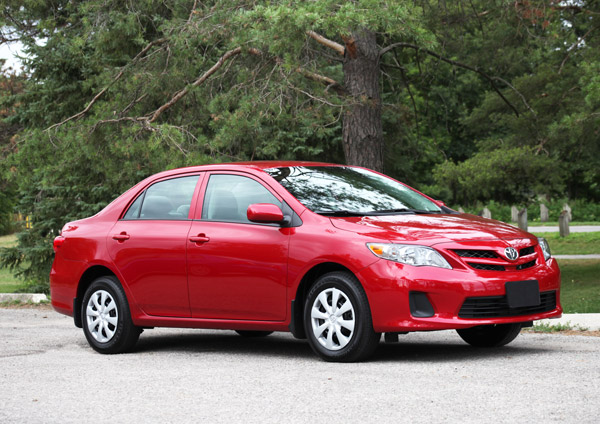
2012 Toyota Corolla
2012 Toyota Corolla
Toyota Motor Company started in 1937 as an offspring of the Toyoda Automatic Loom Works, the textile loom maker. Thanks to its famous production system, Toyota grew from a tiny company into the largest car manufacturer in the world. In the early 60's Japan economy was booming and Toyota recognized the need for a family car for people living in suburbs to get around. That's when the Corolla was born. The first model went on sale in November of 1966 and since then, the Corolla became the world's most popular car. The 2009-2013 Corolla is in its tenth generation. True to its roots, it features a practical comfortable interior, fuel-efficient engine and smooth and quiet ride. In North America, the 2009-2013 Corolla comes only as a 4-door sedan with front wheel drive. We researched this car from the point of view of a used car buyer with these questions in mind: is the Corolla reliable? How good is it on gas? How expensive is it to maintain? How it stacks up against competitors? Here is what we found.
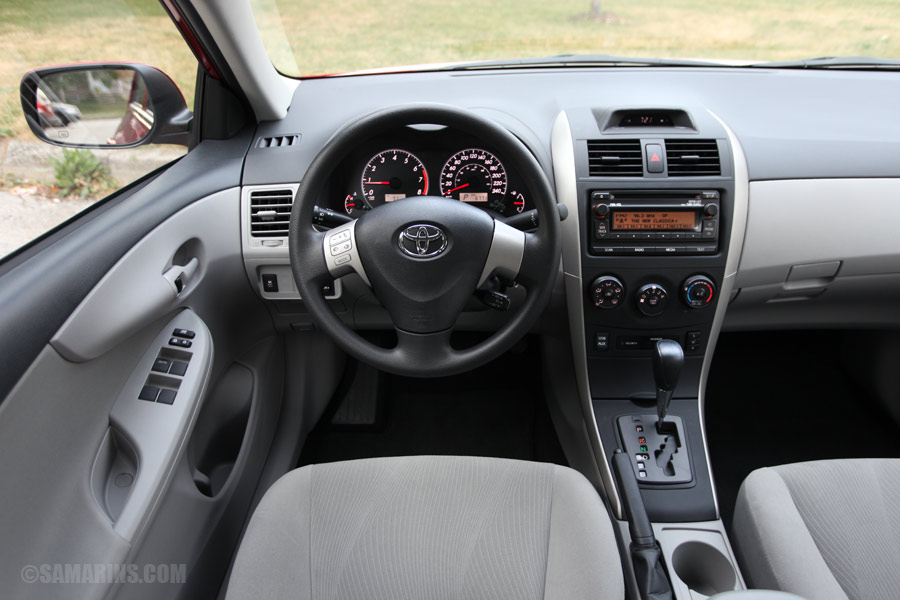
2012 Toyota Corolla
2012 Toyota Corolla interior. Click for larger photo
Toyota Corolla trunk
The trunk offers 12.3 cu. ft. of cargo space.
Interior: The interior is roomy. The seats are higher off the floor than in many other small cars, making entry and exit easier. The Corolla offers more rear seat space than Mitsubishi Lancer, Hyundai Elantra or Nissan Sentra. Rear seats fold down. The trunk is spacious with large opening. The audio auxiliary input is standard, the USB port is available on late models.

Model lineup: In the US, the 2009 Corolla was offered in base, S, LE, upscale XLE and sporty XRS trims. The XLE and XRS were discontinued for 2011 and the L trim became the base level for 2012. In Canada, four models were offered: CE, LE, S and XRS. The S and well-equipped LE are the most widely available trim levels on the used car market.

Powertrain: The main engine is the 132-hp 1.8L 4-cylinder DOHC. It's simple and reliable. With good maintenance it can last for over 200K miles. The Corolla XRS comes with the 158-hp 2.4L 4-cylinder, the same engine as in the Camry and RAV4. Transmission choices include a 4-speed automatic (5-speed automatic in XRS) or 5-speed manual.

Timing belt or chain: Both, the 1.8L and 2.4L engines have a timing chain; there is no timing belt. A timing chain doesn't need to be replaced unless there is a problem with it.

Fuel Economy: The EPA rates the 2011 1.8L automatic Corolla at 26/34 mpg (9.0/6.9 L/100 km), which means that with mostly highway driving you can get up to 380 miles (612 km) to a 13.2-gallon (50.0L) tank.
The manual transmission offers even better fuel economy: 28/35 mpg or 8.4/6.7 liters per hundred kilometers. With a manual transmission, you will be saving around 100 dollars a year on fuel costs compared to the automatic.

Mechanical: The Corolla XRS has disc brakes on all 4 wheels; other models come with rear drum brakes. The steering is electrically powered. Antilock brakes are standard. Vehicle Stability control is optional in early models; standard on all US models from 2010. The Canadian Corolla received standard Vehicle Stability Control for 2011.

Handling and ride: The Corolla is very easy to drive. The ride is soft and quiet; road imperfections are well absorbed by the suspension. The 1.8L engine has enough power for daily commuting. The electrical steering is light and feels fine in the city, but is a bit vague around the center position when driving on the highway. 
Among competitors, Mazda 3 offers sportier handling and rich interior, but only 2012-plus models come with the fuel-efficient Skyactiv engine. Mitsubishi Lancer is also more sporty, but is not as good on gas. Both, Mazda 3 and Mitsubishi Lancer have a stiffer ride compared to the Corolla. Honda Civic is reliable, but some buyers may find its seating position too low compared to the Corolla.
Read about safety, pros and cons, what to look for in a used Toyota Corolla on the next page.
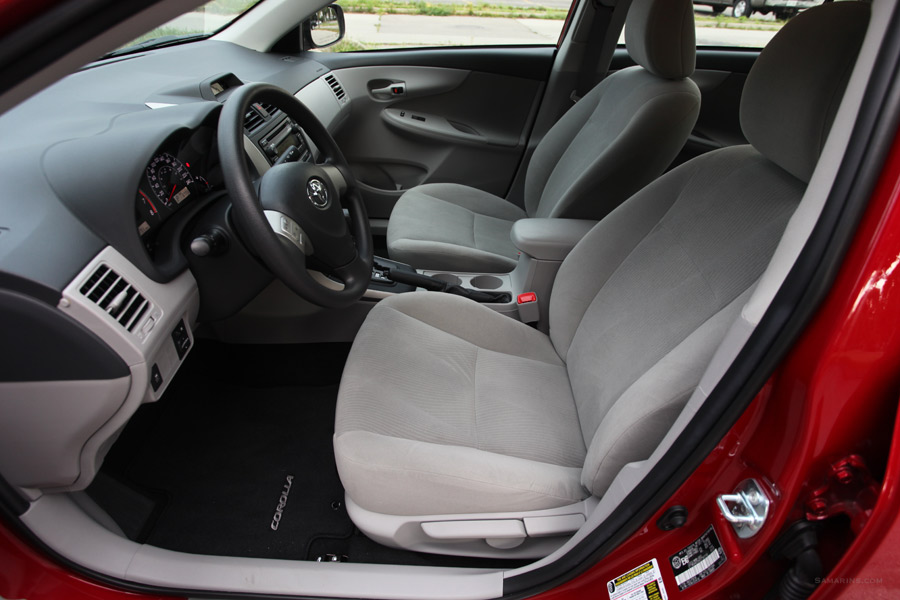
Toyota Corolla front seats
Seats are relatively high off the floor for easy entry and exit
Toyota Corolla rear seats fold down
Rear seats fold down
Toyota Corolla reliability and common problems: The Corolla is reliable and with proper maintenance can last very long. Consumer Reports rates a used Toyota Corolla as 'Good Bet'. Common complaints include a leaking water pump, various noises, brakes wearing fast and minor engine issues.

Safety: The 2009-2010 Toyota Corolla scored 4 stars for both the driver and the front passenger in the NHTSA frontal crash tests. In the side crash tests, the Corolla got 5 stars for the driver and 4 stars for the rear passenger. In 2011, the NHTSA introduced tougher tests, where the 2011 Corolla scored 4 stars in frontal and rollover tests, but only 2 stars in the side crash tests. The upgraded 2012 and 2013 Corolla has earned 5 stars in the side crash tests and 4 stars in the frontal and rollover tests.

Pros: Reliability, soft comfortable ride, fuel economy for 1.8L engine, conventional automatic transmission, crash test scores, easy to drive, practical spacious interior, low ownership costs, resale value.

Cons: Plain styling, interior plastic could be better, engine is a bit underpowered with a full load, not very exciting to drive.

Year to year changes: Toyota Corolla got minor facelift for 2011 with new front grill, head- and taillights, updated bumpers and trunk lid. For 2012, the Corolla received a few feature upgrades, including a new standard audio system with the USB port, Bluetooth and steering audio controls for the US and Canadian LE trim. The US Corolla L received power windows, power door locks and remote keyless entry.

What to look for when buying a used Toyota Corolla: Not all used cars are the same; look for the one that hasn't been involved in an accident and was regularly maintained. When checking the used Corolla, check the engine oil level; if it's very low, the engine may consume oil. If the engine makes loud rattling noise or smokes when started cold, avoid the car. Watch out for leaks in the engine compartment. A rattling noise coming from the passenger side of the engine compartment could indicate a bad belt tensioner or a failing water pump. Water pump failures were common in early models. Make sure to test all the electrical accessories, including the air conditioner and the audio auxiliary input (also common to fail). During the test drive, see how the automatic transmission shifts; all shifts should be smooth. 
Maintenance: To keep your engine in good condition, have your oil changes done regularly. The Scheduled Maintenance Guide for the US 2009 Corolla recommends changing engine oil every six months or 5,000 miles. The Owner's manual for the US 2009 Corolla recommends using SAE 0W-20 oil, which is typically synthetic. It's also important to check the oil level periodically and top up if needed, because some amount of oil is consumed as you drive. Check your transmission fluid regularly and have it changed if it gets too dirty. Rear brakes need to be inspected regularly and serviced as needed.
If you want better traction on snow, consider installing winter tires. You can find the electronic version of an owner's manual, maintenance schedule and how-to videos at the US Toyota Owners website. 

Saturday, February 13, 2016

Peugeot 308 GTi 2015 review


The Peugeot 308 GTi is a five-door hot hatch to rival the Ford Focus ST and VW Golf GTI. Chris Knapman tests the 270 horsepower version to see how it compares. Is its blend of excitement and everyday practicality enough to give it the edge over rivals?

Mercedes-Benz CL (C215) buyers review


Audi A1 2016 review - Car Keys


Audi A1 2016 review - Car Keys

2016 Mahindra XUV500 Automatic Review — Indian road test


Mahindra is a company that was battling an identity crisis, up until recently. The release of the monocoque Mahindra XUV500 (pronounced XUV five-double-o, not five-hundred) was the first vehicle in the brand’s modern resurgence.

The XUV500 broke from the traditional mould of vehicles designed to a very specific market of people that arguably didn’t care for modern car design. The XUV500 is the company’s global SUV product and shows that with a bit of effort, it’s possible to create legible vehicles to cater for global supply.

We jumped on a plane and went to India to test the Mahindra XUV500 on its native ground from Delhi to Agra, Agra to Jaipur and then Jaipur to Delhi. Is it any good? Tune in to find out.

Thursday, February 11, 2016

Range Rover Evoque 2016 review


Range Rover Evoque 2016 review - Car Keys


2016 Mitsubishi Lancer Evolution X Final Edition Review


2016 Mitsubishi Lancer Evolution X Final Edition Review

2016 BMW i3 - Review


2016 BMW i3 - Review


Lamborghini Huracan Spyder review


Lamborghini Huracan Spyder review: the best-looking roadster on sale?


The Lamborghini Huracan is on something of a roll at the moment. Having started life with a surprisingly muffled bang, it’s matured and got better since its introduction to the world in 2013, with improved four- and two-wheel drive versions both appearing within the last six months. 

And now Lamborghini has presented us with this model, the all-new Spyder complete with a brilliant folding hood mechanism, drop dead gorgeous good looks and, best of all, that same 5.2-litre V10 engine screaming away behind your head.

2016 Honda Accord review


2016 Honda Accord review from Family Wheels
A family friendly look at the 2016 Honda Accord... and a comparison of how it stacks up to the brand new Honda Civic that we reviewed just last week.


2016 Bentley Bentayga Review : First Drive


Yes, this is a Bentley SUV and you’d better get used to it, because it will undoubtedly become the best-selling model in the British brand’s proud history.

The Bentley Bentayga is the world’s most expensive SUV, with its Australian price starting from about $420,000 for the initial version of the car equipped with an all-new W12 twin-turbo engine.

Before we get into it, we must address the elephant in the room. The Bentley Bentayga may not be what many would call pretty, but it’s certainly very striking in the flesh, possessing a lot of presence – particularly from the front. The rear is more conservative, but it all works together as a package.

Furthermore, Bentley making an SUV is merely a sign of the times. When Porsche came out with the first Cayenne SUV back in 2002, many said it was the end for the German performance brand, having given over its sporting soul to making SUVs. Fast forward to today and SUVs account for nearly two thirds of all things from Porsche, but it hasn’t had any negative effect on purist models like the 911 or the Boxster. In fact, it’s the income from SUVs that has allowed Porsche to make cars such as the 911.

The case with the Bentley Bentayga is a little different, as the company claims to not need the money to fund its other models, and that it has instead made an SUV due to enormous customer demand. It makes sense, as large super-luxury sedans are becoming a tad old-school – so why not make super-luxury SUVs?

2016 BMW X1 xDrive 20d Review


This is the all-new 2016 BMW X1, the latest contender in the small but premium SUV segment.

Wednesday, February 10, 2016

Audi A4 and A4 Avant 2016 review


The 2016 Audi A4 is a rival to the BMW 3-series, Mercedes C-class and Jaguar XE, but does it have what it takes to go to the top of the class? Rebecca Jackson puts both the saloon and Avant estate version through their paces to find out.

2016 Lincoln MKX Review


Like it or not, Lincoln has a reputation for appealing to a decidedly older clientele, but does the all-new MKX crossover have the style and technology to lure in a new generation of buyers?

2016 Ford Explorer Limited Full Review


2016 Ford Explorer Limited 3.5L V6 in White Platinum Metallic with full black Perforated Leather interior. The Ford Explorer Platinum is the top of the line version, follow by the Ford Explorer Sport. In this Video, we going to Start up the engine, Listen to the Exhaust sound as well as take an In Depth review of the interior and exterior and take it out for a short drive. Hope you guy enjoy the 2015 Ford Explorer Limited Edition.

Lexus RC coupe 2016 review


Lexus RC coupe 2016 review - Carbuyer


2016 Toyota Prius Review


The 2016 Toyota Prius is the forth generation of this iconic car. The all-new Toyota Prius hybrid is longer, wider and lower built on an all-new global architecture. This provides a more sophisticated ride, better handling and improved fuel economy. The 2016 Toyota Prius is a mid-sized hatchback with room for 5-pasengers and loaded with all kinds of new tech including advanced safety features and in-car comfort features like wireless smartphone charging. Toyota hopes this new Prius will also appeal to non hybrid owners.

Tuesday, February 9, 2016

2016 Ford Ranger Wildtrak review


2016 Ford Ranger Wildtrak review | Torquing Heads video

Peter Anderson and Nikki Cousins road test and review the Ford Ranger Wildtrak ute.